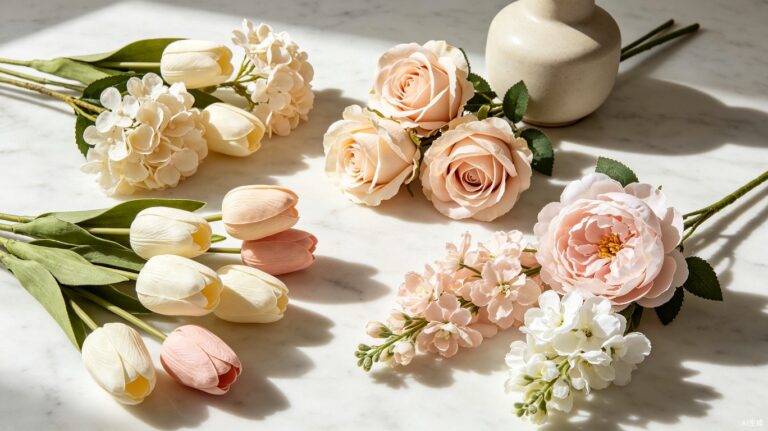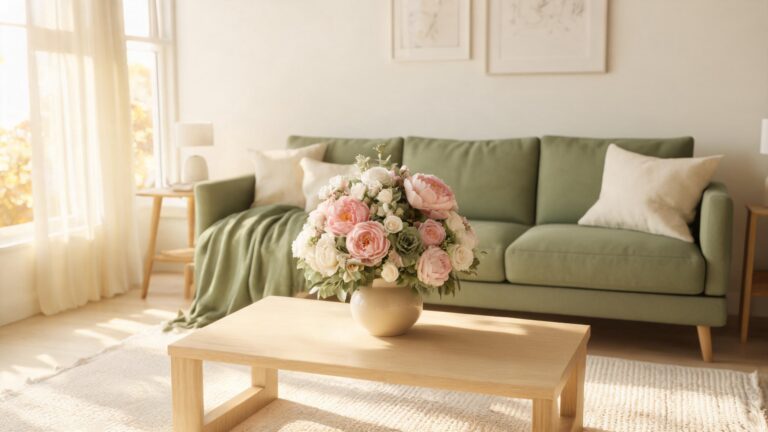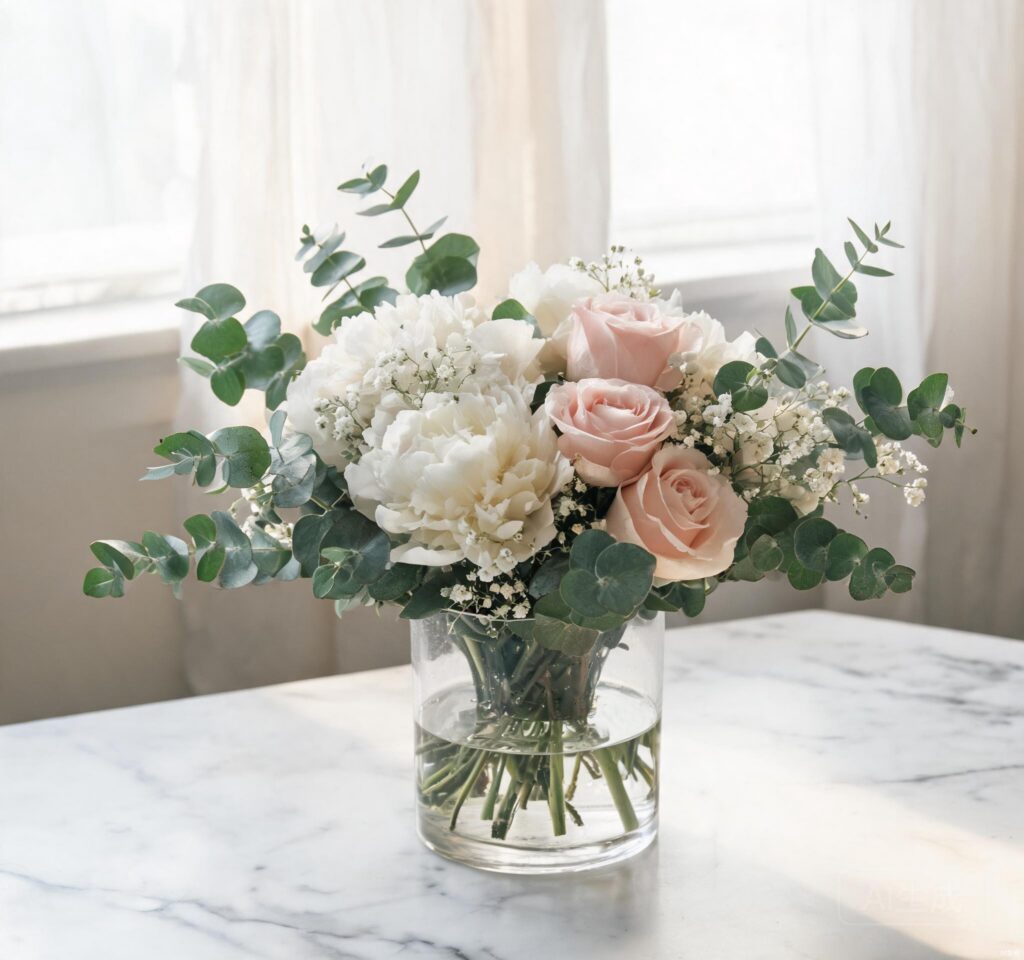
Arrange artificial flowers in a vase by following three rules: use the 1.5x height rule (arrangement = 1.5x vase height), build in three layers (greenery base, focal flowers at staggered heights, filler blooms to fill gaps), and vary every element (no two flowers at the same height, no stems perfectly straight). This works for any vase type and any flower combination.
How to Arrange Artificial Flowers in a Vase: 6 Steps
This method works for any vase and any combination of artificial flowers. Total time: 15-20 minutes.
Step 1: Choose Your Vase and Measure
Measure the vase height. Your finished arrangement will stand 1.5 to 2 times taller than the vase itself. This ratio works universally regardless of vase shape or material — for exact per-vase measurements, see our vase sizing guide for artificial flowers.
Step 2: Sort Stems by Role
Group your flowers into three categories before touching the vase.
- Focal flowers (3-5 stems): Your largest blooms — peonies, hydrangeas, large roses. These draw the eye.
- Filler flowers (4-6 stems): Medium blooms — tulips, spray roses, ranunculus. These add body and color transitions.
- Greenery (3-5 stems): Eucalyptus, ivy, olive branches. These create the natural framework.
Step 3: Build the Greenery Base
Place 3-4 greenery stems around the vase rim at 10 o’clock, 2 o’clock, and 6 o’clock positions. Angle them slightly outward so they drape naturally over the edge. This creates a soft collar that hides the vase opening.
Step 4: Place Focal Flowers at Staggered Heights
Insert your largest blooms at different heights — the tallest at the center-back, medium-tall on the sides, and the shortest near the front rim. No two focal flowers should sit at exactly the same level.
Step 5: Fill Gaps with Filler Flowers
Tuck medium blooms into the spaces between focal flowers. Position them at mid-height, slightly lower than the focal blooms they sit beside. Rotate the vase 360 degrees after every 2-3 stems to maintain balanced coverage.
Step 6: Final Check from 3 Feet Away
Step back about 3 feet from the arrangement. Look for these three problems and fix them.
- ✓ Any two flowers at the same height? Lower one by 1-2 inches.
- ✓ A visible gap from any angle? Add one filler stem there.
- ✓ Stems looking too stiff? Bend the wire inside to tilt the flower head 10-15 degrees.
Best Vase Types for Artificial Flower Arrangements
The vase material and shape affect the overall look as much as the flowers themselves. Match your vase to your decor style and flower type.
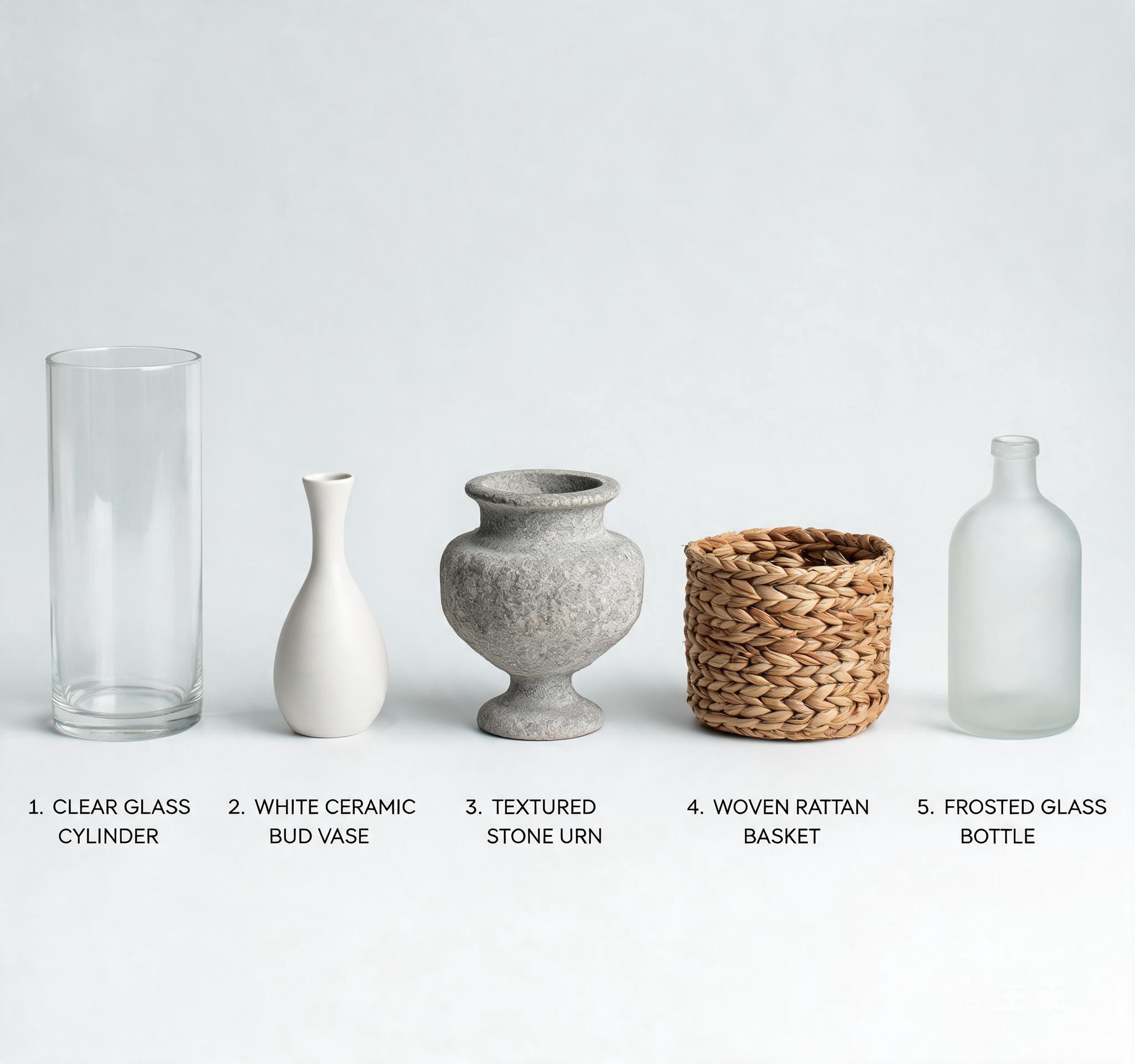
Figure 1: Five vase types that work best with artificial flowers
| Vase Type | Best For | Style | Pro Tip |
|---|---|---|---|
| Glass Cylinder | Roses, tulips, mixed bouquets | Modern, minimalist | Fill with clear marbles to hide stems |
| Ceramic Bud Vase | 1-3 stems, single bloom | Japanese, wabi-sabi | Matte finish hides stem insertion points |
| Stone or Concrete | Hydrangeas, branches, large arrangements | Rustic, farmhouse | Weighted base prevents tipping with tall stems |
| Rattan or Woven Basket | Wildflowers, lavender, dried-style | Bohemian, cottage | Line with a hidden jar or use floral foam |
| Frosted Glass Bottle | Tulips, cherry blossoms, delicate stems | Romantic, vintage | Narrow neck naturally holds stems in place |
6 Common Mistakes (and How to Fix Them)
These are the errors that make artificial flower arrangements look fake. Avoid all six and your arrangement will look professionally done.
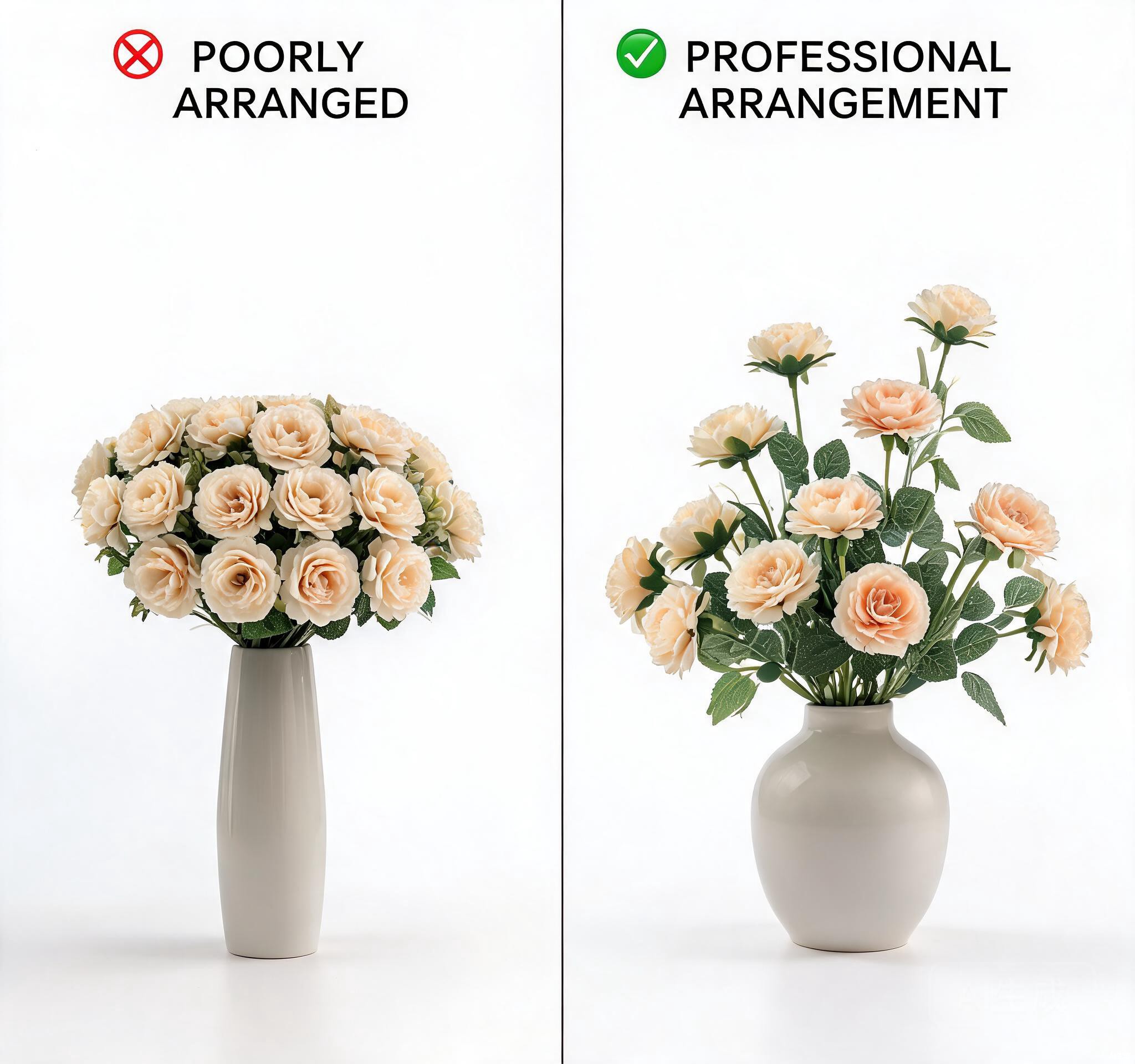
Figure 2: Common mistakes vs. professional results
- All flowers at the same height. Stagger every stem by at least 1-2 inches. The tallest goes center-back; the shortest sits at the front rim.
- Too few stems. An arrangement needs 30-50% more flowers than looks “enough” in your hand. Sparse arrangements read as fake.
- No greenery. Without leaves or eucalyptus, the color palette looks flat. Greenery breaks up flower mass and adds natural movement.
- Stems perfectly straight. Bend the internal wire at the base so each flower tilts 10-20 degrees outward. Real flowers never grow straight up.
- Wrong vase proportion. A tiny vase with massive hydrangeas looks top-heavy. Follow the 1.5x rule: arrangement height = 1.5x vase height.
- Ignoring the 360-degree view. Check your arrangement from all sides. A flat back or one good angle looks artificial from other viewpoints.
Color Combinations That Look Natural
The right color palette separates an arrangement that looks “decorated” from one that looks like it grew there. Follow the 60-30-10 rule for any combination.
The 60-30-10 Color Rule
- 60% dominant: Your base color — white, cream, blush pink, or soft sage. This fills the most visual space.
- 30% secondary: A complementary tone — dusty rose, lavender, soft gold, or pale blue. This adds depth.
- 10% accent: One bold color — deep burgundy, rich navy, burnt orange. Just 1-2 stems for visual pop.
4 Proven Color Palettes
| Palette Name | Colors | Best Flowers | Room Vibe |
|---|---|---|---|
| Classic Neutral | White, cream, blush, sage | White peonies, cream roses, eucalyptus | Living room, entryway |
| Romantic Blush | Blush pink, dusty rose, burgundy | Pink roses, peonies, deep red ranunculus | Bedroom, dining room |
| Garden Fresh | White, lavender, soft yellow, green | Tulips, lavender, daisies, olive branch | Kitchen, sunroom |
| Moody Elegance | Burgundy, navy, gold, deep green | Dark red roses, thistle, seeded eucalyptus | Office, library, fall/winter |
How to Keep Stems in Place
Artificial flowers are lighter than real ones, so they can shift in the vase. These three methods keep everything stable.
- Crisscross method: Insert stems in an X pattern at the base. Each new stem locks against the previous one. Works for glass and ceramic vases.
- Filler material: Add clear marbles, river stones, or acrylic water beads to the vase bottom. These anchor lightweight artificial stems.
- Cluster taping: Tape 3-4 stems together with floral tape at the midpoint before inserting. Creates a self-supporting mini-bouquet.
Top Pick: A Mixed Bouquet That Arranges Itself
The easiest way to nail the steps above is to start with stems that already vary in height, color, and bloom size — which is exactly what a mixed bouquet gives you.
- Product: 11 Stems Original Artificial Flowers Bouquet — peony, hydrangea, rose, and dahlia mix
- Price: $46.99 with free shipping
- Why it fits this article: four bloom sizes in warm tones give you the focal-to-filler range the 6-step method needs, without buying stems separately
Shop the 11-stem Original Bouquet →
Frequently Asked Questions
How do you arrange artificial flowers in a vase so they look real?
The key is varying heights, mixing flower types, and adding greenery. Use the 1.5x rule, place focal flowers at staggered heights, fill gaps with smaller blooms, and surround the base with eucalyptus or ivy. Avoid placing stems at perfect right angles — slight tilts look more natural.
What is the 1.5x rule for flower arrangements?
The 1.5x rule states that the total height of your flower arrangement should be approximately 1.5 times the height of your vase. For example, a 10-inch vase should hold an arrangement that stands about 15 inches tall. This ratio creates visual balance and prevents arrangements from looking too sparse or top-heavy. Pairing the rule with a hydrangea centerpiece looks best when you follow our artificial hydrangea arrangement guide.
How many artificial flowers do you need for a vase?
For a standard 8-10 inch vase: 3-5 large focal flowers, 4-6 medium flowers, and 3-4 greenery stems (10-15 total). For bud vases, 1-3 stems suffice. Add 30% more if you want a full, lush look. Our complete vase sizing guide breaks down stem count by vase shape.
Do you need floral foam for artificial flower arrangements?
Floral foam is optional. Wire-reinforced stems hold position without foam. For glass vases, use clear marbles or river stones instead. Foam is most useful for wide-mouthed containers where stems need extra anchoring.
How do you keep artificial flowers from falling over in a vase?
Three methods: crisscross stems at the base for internal support, add clear marbles or river stones to anchor stems, or use floral tape to secure 3-4 stems together before inserting as a cluster.
What color artificial flowers go together?
Follow the 60-30-10 rule: 60% dominant color (white, cream, blush), 30% complementary (sage green, dusty rose, lavender), and 10% accent (burgundy, gold, navy). Monochromatic arrangements in varying shades also look sophisticated.
Can you mix real and artificial flowers in the same vase?
Yes. Use high-quality Real Touch or silk flowers so textures blend. Place artificial flowers in the center and back, and real flowers at the front and edges where they’re most visible and closest to the viewer.
How do you make artificial flower arrangements look fuller?
Fluff petals outward before arranging. Bend stems so flowers face different directions. Add baby’s breath between larger blooms. Layer greenery at multiple heights. Use 30-50% more stems than you think you need.
Shop Arrangement-Ready Artificial Flowers
Every BloomWitness stem is wire-reinforced and hand-finished for easy arranging. Mix and match with confidence.